 |
ryujin 2.5.0 revision c64172211cf21344cb9b9b0f3a1266aa6400d392
|
Loading...
Searching...
No Matches
|
ryujin 2.5.0 revision c64172211cf21344cb9b9b0f3a1266aa6400d392
|
#include <include/ryujin/output/error_evaluation.h>
Public Member Functions | |
Constructor and setup | |
| ErrorEvaluation (const Interface::Simulation< dim, Number > &simulation, const std::string &subsection="/ErrorEvaluation") | |
Task | |
| void | initialize (TaskContext< Number > &context) override |
| void | execute (TaskContext< Number > &context) override |
| void | finalize (TaskContext< Number > &context) override |
 Public Member Functions inherited from ryujin::Interface::Task< Number > | |
| virtual | ~Task ()=default |
| virtual void | start (TaskContext< Number > &) |
| virtual void | prepare (TaskContext< Number > &) |
| virtual void | save (boost::archive::binary_oarchive &) const |
| virtual void | load (boost::archive::binary_iarchive &) |
Additional Inherited Members | |
| Protected Member Functions inherited from ryujin::Interface::Task< Number > | |
| Task (const std::string &name, TaskPhase phase) | |
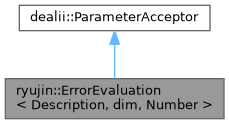
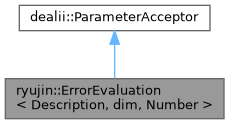
The ErrorEvaluation class computes error norms of the numerical solution with respect to an analytic solution.
The analytic solution is provided by the InitialValues class, i.e., the selected initial state configuration is evaluated at the current time. Consequently, error evaluation is only meaningful for initial state configurations that describe an exact (time-dependent) solution of the underlying equations.
The quantities for which the error is computed can be freely chosen via a configuration file, as well as the error norms (L1, L2, Linf). The individual errors are then consolidated by summing over all selected quantities (and, if applicable, over all MPI ensembles). The result is one number per selected norm.
The class is the task "error evaluation" that writes out the computed error into a log file <base name>-error.log whenever its trigger fires, and prints a summary of the error at the final time.
Definition at line 47 of file error_evaluation.h.
| ryujin::ErrorEvaluation< dim, Number >::ErrorEvaluation | ( | const Interface::Simulation< dim, Number > & | simulation, |
| const std::string & | subsection = "/ErrorEvaluation< dim, Number >" |
||
| ) |
Constructor.
|
overridevirtual |
Initialize error evaluation: validate the selected quantities and norms.
The base name is used for the error log file <basename>-error.log. Calling initialize() resets the log file and writes out a header describing its contents.
Reimplemented from ryujin::Interface::Task< Number >.
|
overridevirtual |
Append the error at the current time to the error log file whenever the trigger fires.
Implements ryujin::Interface::Task< Number >.
|
overridevirtual |
Print a summary of the error at the final time.
Reimplemented from ryujin::Interface::Task< Number >.
 1.9.8