 |
ryujin 2.5.0 revision c64172211cf21344cb9b9b0f3a1266aa6400d392
|
Loading...
Searching...
No Matches
|
ryujin 2.5.0 revision c64172211cf21344cb9b9b0f3a1266aa6400d392
|
#include <include/ryujin/euler/initial_state_noh.h>
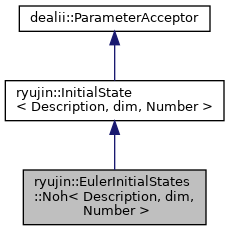
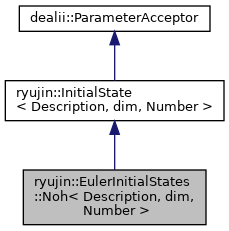
Public Types | |
| using | HyperbolicSystem = typename Description::HyperbolicSystem |
| using | View = typename HyperbolicSystem::template View< dim, Number > |
| using | state_type = typename View::state_type |
 Public Types inherited from ryujin::InitialState< Description, dim, Number > | |
| using | HyperbolicSystem = typename HyperbolicDescription::HyperbolicSystem |
| using | View = typename HyperbolicSystem::template View< dim, Number > |
| using | state_type = typename View::state_type |
| using | initial_precomputed_type = typename View::initial_precomputed_type |
Public Member Functions | |
| Noh (const HyperbolicSystem &hyperbolic_system, const std::string &subsection) | |
| auto | compute (const dealii::Point< dim > &point, Number t) -> state_type final |
| Public Member Functions inherited from ryujin::InitialState< Description, dim, Number > | |
| InitialState (const std::string &name, const std::string &subsection) | |
| virtual initial_precomputed_type | initial_precomputations (const dealii::Point< dim > &) |
The Noh problem
This initial state sets up the classical Noh problem introduced in [19]
t and position x. Definition at line 27 of file initial_state_noh.h.
| using ryujin::EulerInitialStates::Noh< Description, dim, Number >::HyperbolicSystem = typename Description::HyperbolicSystem |
Definition at line 30 of file initial_state_noh.h.
| using ryujin::EulerInitialStates::Noh< Description, dim, Number >::View = typename HyperbolicSystem::template View<dim, Number> |
Definition at line 31 of file initial_state_noh.h.
| using ryujin::EulerInitialStates::Noh< Description, dim, Number >::state_type = typename View::state_type |
Definition at line 32 of file initial_state_noh.h.
|
inline |
Definition at line 34 of file initial_state_noh.h.
|
inlinefinalvirtual |
Given a position point returns the corresponding (conserved) initial state. The function is used to interpolate initial values and enforce Dirichlet boundary conditions. For the latter, the function signature has an additional parameter t denoting the current time to allow for time-dependent (in-flow) Dirichlet data.
Implements ryujin::InitialState< Description, dim, Number >.
Definition at line 71 of file initial_state_noh.h.
References ryujin::min.
 1.9.8