 |
ryujin 2.1.1 revision b04fb4aba7bd97ddfa5994a6b4b6e8586eb15db2
|
Loading...
Searching...
No Matches
|
ryujin 2.1.1 revision b04fb4aba7bd97ddfa5994a6b4b6e8586eb15db2
|
#include <source/offline_data.h>
Classes | |
| struct | CouplingDescription |
Public Types | |
Typedefs and constexpr constants | |
| using | BoundaryDescription = std::tuple< unsigned int, dealii::Tensor< 1, dim, Number >, Number, Number, dealii::types::boundary_id, dealii::Point< dim > > |
Public Member Functions | |
| template<typename ITERATOR1 , typename ITERATOR2 > | |
| auto | construct_boundary_map (const ITERATOR1 &begin, const ITERATOR2 &end, const Utilities::MPI::Partitioner &partitioner) const -> BoundaryMap |
| template<typename ITERATOR1 , typename ITERATOR2 > | |
| auto | collect_coupling_boundary_pairs (const ITERATOR1 &begin, const ITERATOR2 &end, const Utilities::MPI::Partitioner &partitioner) const -> CouplingBoundaryPairs |
Constructor and setup | |
| OfflineData (const MPIEnsemble &mpi_ensemble, const Discretization< dim > &discretization, const std::string &subsection="/OfflineData") | |
| void | prepare (const unsigned int problem_dimension, const unsigned int n_precomputed_values) |
Information and statistics | |
| const auto & | dof_handler_cg () const |
| const auto & | dof_handler_dg () const |
| const dealii::DoFHandler< dim > & | dof_handler () const |
| dealii::DoFHandler< dim > & | dof_handler () |
| const auto & | affine_constraints_cg () const |
| const auto & | affine_constraints_dg () const |
| const dealii::AffineConstraints< Number > & | affine_constraints () const |
| const auto & | scalar_partitioner () const |
| const auto & | hyperbolic_vector_partitioner () const |
| const auto & | precomputed_vector_partitioner () const |
| const auto & | n_export_indices () const |
| const auto & | n_locally_internal () const |
| const auto & | n_locally_owned () const |
| const auto & | n_locally_relevant () const |
| const auto & | boundary_map () const |
| const auto & | boundary_indices () const |
| const auto & | boundary_slots () const |
| const auto & | coupling_boundary_pairs () const |
| const auto & | level_boundary_map () const |
| const auto & | sparsity_pattern () const |
| const auto & | sparsity_pattern_simd () const |
| const auto & | mass_matrix () const |
| const auto & | mass_matrix_inverse () const |
| const auto & | lumped_mass_matrix () const |
| const auto & | lumped_mass_matrix_inverse () const |
| const auto & | level_lumped_mass_matrix () const |
| const auto & | betaij_matrix () const |
| const auto & | cij_matrix () const |
| const auto & | incidence_matrix () const |
| const auto & | measure_of_omega () const |
| const auto & | discretization () const |
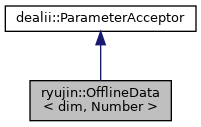
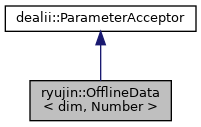
A class to store all data that can be precomputed offline.
This class takes a reference to a Discretization object (that itself holds a Triangulation, FiniteElement, Mapping, and Quadrature object).
Most notably this class sets up a DoFHandler, the SparsityPattern, various IndexSet objects to hold locally owned and locally relevant indices, and precomputes all matrices (mass matrix, lumped mass matrix, $c_{ij}$ matrices, and $n_{ij}$ matrices).
After prepare() is called, all getter functions return valid references.
Definition at line 53 of file offline_data.h.
| using ryujin::OfflineData< dim, Number >::BoundaryDescription = std::tuple<unsigned int , dealii::Tensor<1, dim, Number> , Number , Number , dealii::types::boundary_id , dealii::Point<dim> > |
A tuple describing (local) dof index, boundary normal, normal mass, boundary mass, boundary id, and position of the boundary degree of freedom.
Definition at line 66 of file offline_data.h.
| ryujin::OfflineData< dim, Number >::OfflineData | ( | const MPIEnsemble & | mpi_ensemble, |
| const Discretization< dim > & | discretization, | ||
| const std::string & | subsection = "/OfflineData< dim, Number >" |
||
| ) |
Constructor
Definition at line 33 of file offline_data.template.h.
| void ryujin::OfflineData< dim, Number >::prepare | ( | const unsigned int | problem_dimension, |
| const unsigned int | n_precomputed_values | ||
| ) |
Prepare offline data. A call to prepare() sets up storage, dof handlers, sparsity patterns, and assembles all matrices.
The problem_dimension and n_precomputed_values parameters is used to set up appropriately sized vector partitioners for the state and precomputed MultiComponentVector.
Definition at line 69 of file offline_data.template.h.
|
inline |
Return a read-only const reference to the DoFHandler for the continuous ("cG") variant of the selected finite element space.
Definition at line 124 of file offline_data.h.
Referenced by ryujin::MGSmoother< dim, Number >::initialize().
|
inline |
Return a read-only const reference to the DoFHandler for the discontinuous ("dG") variant of the selected finite element space.
Definition at line 133 of file offline_data.h.
|
inline |
Return a read-only const reference to the dof handler.
Definition at line 138 of file offline_data.h.
Referenced by ryujin::MGSmoother< dim, Number >::initialize().
|
inline |
Return a writable reference to the dof handler.
Definition at line 152 of file offline_data.h.
|
inline |
An AffineConstraints object storing constraints for the continuous ("cG") variant of the selected finite element space in (deal.II typical) global numbering.
Definition at line 175 of file offline_data.h.
|
inline |
An AffineConstraints object storing constraints for the discontinuous ("dG") variant of the selected finite element space in (deal.II typical) global numbering.
Definition at line 189 of file offline_data.h.
|
inline |
An AffineConstraints object storing constraints in (deal.II typical) global numbering.
Definition at line 199 of file offline_data.h.
|
inline |
An MPI partitioner for the (scalar) Vector storing a scalar-valued quantity.
Definition at line 212 of file offline_data.h.
|
inline |
An MPI partitioner for the MultiComponentVector storing a vector-valued quantity of size HyperbolicSystem::problem_dimension.
Definition at line 218 of file offline_data.h.
|
inline |
An MPI partitioner for the MultiComponentVector storing a vector-valued quantity of size HyperbolicSystem::problem_dimension.
Definition at line 224 of file offline_data.h.
|
inline |
The subinterval \([0,\texttt{n_export_indices()})\) contains all (SIMD-vectorized) indices of the interval \([0,\texttt{n_locally_internal()})\) that are exported to neighboring MPI ranks.
Definition at line 237 of file offline_data.h.
|
inline |
Number of locally owned internal degrees of freedom: In (MPI rank) local numbering all indices in the half open interval [0, n_locally_internal_) are owned by this processor, have standard connectivity, and are not situated at a boundary.
Definition at line 245 of file offline_data.h.
Referenced by ryujin::Euler::HyperbolicSystem::fill_precomputed_values(), ryujin::EulerAEOS::HyperbolicSystem::fill_precomputed_values(), ryujin::EulerBarotropic::HyperbolicSystem::fill_precomputed_values(), ryujin::ScalarConservation::HyperbolicSystem::fill_precomputed_values(), and ryujin::ShallowWater::HyperbolicSystem::fill_precomputed_values().
|
inline |
Number of locally owned degrees of freedom: In (MPI rank) local numbering all indices in the half open interval [0, n_locally_owned_) are owned by this processor.
Definition at line 252 of file offline_data.h.
Referenced by ryujin::Euler::HyperbolicSystem::fill_precomputed_values(), ryujin::EulerAEOS::HyperbolicSystem::fill_precomputed_values(), ryujin::EulerBarotropic::HyperbolicSystem::fill_precomputed_values(), ryujin::ScalarConservation::HyperbolicSystem::fill_precomputed_values(), and ryujin::ShallowWater::HyperbolicSystem::fill_precomputed_values().
|
inline |
Number of locally relevant degrees of freedom: This number is the total number of degrees of freedom we store locally on this MPI rank. I.e., we can access the half open interval [0, n_locally_relevant_) on this machine.
Definition at line 260 of file offline_data.h.
|
inline |
The boundary map. Local numbering.
For every degree of freedom that has nonzero support at the boundary we record the global degree of freedom index along with a weighted boundary normal, the associated boundary id, and position.
This map is later used in OfflineData to handle boundary degrees of freedom after every time step (for example to implement reflective boundary conditions).
Definition at line 273 of file offline_data.h.
Referenced by ryujin::NavierStokes::VelocityMatrix< dim, Number, Number2 >::vmult(), and ryujin::NavierStokes::EnergyMatrix< dim, Number, Number2 >::vmult().
|
inline |
A compacted, strictly increasing list of all locally owned degrees of freedom that appear in the boundary_map(). The function returns a reference to a Mirrored object that can be accessed on both memory spaces with view() and size().
Definition at line 281 of file offline_data.h.
|
inline |
For every entry of the boundary_map() the position of its degree of freedom in boundary_indices(). Local numbering.
Definition at line 292 of file offline_data.h.
|
inline |
An array of CouplingDescription structures describing coupling degrees of freedom i and j where both degrees of freedom are collocated at the boundary (and hence the d_ij matrix has to be symmetrized). The function returns a reference to a Mirrored object holding (i, col_idx, j) triples that can be accessed on both memory spaces with view() and size().
Definition at line 302 of file offline_data.h.
|
inline |
The boundary map on all levels of the grid in case multilevel support was enabled.
Definition at line 308 of file offline_data.h.
Referenced by ryujin::NavierStokes::EnergyMatrix< dim, Number, Number2 >::compute_diagonal(), ryujin::NavierStokes::VelocityMatrix< dim, Number, Number2 >::compute_diagonal(), ryujin::NavierStokes::VelocityMatrix< dim, Number, Number2 >::vmult(), and ryujin::NavierStokes::EnergyMatrix< dim, Number, Number2 >::vmult().
|
inline |
A sparsity pattern for (standard deal.II) matrices storing indices in (deal.II typical) global numbering.
Definition at line 314 of file offline_data.h.
|
inline |
A sparsity pattern for matrices in vectorized format. Local numbering.
Definition at line 320 of file offline_data.h.
Referenced by ryujin::Euler::HyperbolicSystem::fill_precomputed_values(), ryujin::EulerAEOS::HyperbolicSystem::fill_precomputed_values(), ryujin::EulerBarotropic::HyperbolicSystem::fill_precomputed_values(), ryujin::ScalarConservation::HyperbolicSystem::fill_precomputed_values(), and ryujin::ShallowWater::HyperbolicSystem::fill_precomputed_values().
|
inline |
The mass matrix. (SIMD storage, local numbering)
Definition at line 325 of file offline_data.h.
|
inline |
The inverse mass matrix. (SIMD storage, local numbering)
This matrix is only available for a discontinuous finite Element ansatz.
Definition at line 333 of file offline_data.h.
|
inline |
The lumped mass matrix. (stored as vector, local numbering)
Definition at line 338 of file offline_data.h.
Referenced by ryujin::NavierStokes::VelocityMatrix< dim, Number, Number2 >::vmult(), and ryujin::NavierStokes::EnergyMatrix< dim, Number, Number2 >::vmult().
|
inline |
The inverse of the lumped mass matrix. (stored as vector, local numbering)
Definition at line 344 of file offline_data.h.
|
inline |
The lumped mass matrix on all levels of the grid in case multilevel support was enabled.
Definition at line 350 of file offline_data.h.
Referenced by ryujin::NavierStokes::EnergyMatrix< dim, Number, Number2 >::compute_diagonal(), ryujin::NavierStokes::VelocityMatrix< dim, Number, Number2 >::compute_diagonal(), ryujin::NavierStokes::VelocityMatrix< dim, Number, Number2 >::vmult(), and ryujin::NavierStokes::EnergyMatrix< dim, Number, Number2 >::vmult().
|
inline |
The stiffness matrix \((beta_{ij})\): \(\beta_{ij} = \nabla\varphi_{j}\cdot\nabla\varphi_{i}\) (SIMD storage, local numbering)
Definition at line 357 of file offline_data.h.
|
inline |
The \((c_{ij})\) matrix. (SIMD storage, local numbering)
Definition at line 362 of file offline_data.h.
|
inline |
The incidence matrix \((beta_{ij})\): 1 for coupling face degrees of freedom that share the same support point coordinate, 0 otherwise.
(SIMD storage, local numbering)
This matrix is only available for a discontinuous finite Element ansatz.
Definition at line 373 of file offline_data.h.
|
inline |
Size of computational domain.
Definition at line 378 of file offline_data.h.
|
inline |
Returns a reference of the underlying Discretization object.
Definition at line 383 of file offline_data.h.
Referenced by ryujin::MGSmoother< dim, Number >::initialize().
| auto ryujin::OfflineData< dim, Number >::construct_boundary_map | ( | const ITERATOR1 & | begin, |
| const ITERATOR2 & | end, | ||
| const Utilities::MPI::Partitioner & | partitioner | ||
| ) | const -> BoundaryMap |
Definition at line 1244 of file offline_data.template.h.
References ryujin::no_slip, ryujin::periodic, and ryujin::slip.
| auto ryujin::OfflineData< dim, Number >::collect_coupling_boundary_pairs | ( | const ITERATOR1 & | begin, |
| const ITERATOR2 & | end, | ||
| const Utilities::MPI::Partitioner & | partitioner | ||
| ) | const -> CouplingBoundaryPairs |
Definition at line 1469 of file offline_data.template.h.
References ryujin::periodic.
 1.9.8
1.9.8