 |
ryujin 2.5.0 revision 3a6c8d57210175dea14d8116e1fe878f349f8c1c
|
Loading...
Searching...
No Matches
|
ryujin 2.5.0 revision 3a6c8d57210175dea14d8116e1fe878f349f8c1c
|
#include <include/ryujin/interface/postprocessor.h>
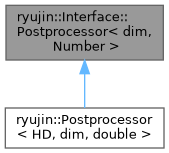
Classes | |
| struct | Selection |
Public Member Functions | |
| virtual | ~Postprocessor ()=default |
| virtual Selection | prepare (const std::vector< std::string > &selected) const =0 |
| virtual std::vector< ScalarHostVector< Number > > | extract (const Selection &selection, const StateVector< Number > &state_vector) const =0 |
| virtual void | extract (const Selection &selection, const StateVector< Number > &state_vector, const unsigned int *indices, const unsigned int n_points, Number *values) const =0 |
The description-free interface of a Postprocessor: the extraction of selected (and postprocessed) components out of a state vector.
A component can be selected by any of its conserved, primitive, precomputed, initial-precomputed, or parabolic name. In addition, the following postprocessed quantities can be selected:
\[ q_i = \Big|\frac{1}{m_i}\sum_{j\in \mathcal{J}(i)} \mathbf{c}_{ij} u_j\Big|; \]
\[ \mathbf q_i = \frac{1}{m_i}\sum_{j\in \mathcal{J}(i)} \mathbf{c}_{ij} \times \mathbf{u}_j. \]
A single postprocessor serves several callers: every caller stores the selection returned by prepare() and passes it to extract().
Intended usage:
Definition at line 58 of file postprocessor.h.
|
virtualdefault |
Destructor.
|
pure virtual |
Look up the list of selected component names and return the corresponding selection.
Implemented in ryujin::Postprocessor< Description, dim, Number >, and ryujin::Postprocessor< HD, dim, double >.
|
pure virtual |
Extract all quantities of selection out of state_vector and return them as a vector of host vectors with one entry per selected quantity, in the order in which the quantities have been selected in prepare().
|
pure virtual |
Extract all quantities of selection at the degrees of freedom indices[p], p = 0, ..., n_points - 1, out of state_vector:
The extraction runs on the memory space selected_memory_space_t, and both pointers refer to it. Depending on the transfer policy of the individual vectors this either asserts that the memory space is resident, or triggers an implicit memory transfer.
 1.9.8